CompTIA A+ 220-1201 Objective 3.2 expects you to recognize network cables and choose the right one for the job. That choice affects speed, distance limits, signal quality, safety codes, and how harsh the install site is (ceiling spaces, outdoors, or underground). In the field, a bad cable pick wastes time and can fail an inspection.
This objective centers on two cable families: copper and fiber. Copper is common for endpoint connections, and fiber is used when you need longer runs, higher bandwidth, or strong noise resistance. You should be able to identify each type on sight and match it to a real support ticket.
You’ll review twisted-pair copper categories and what they imply for performance, then the T568A and T568B wiring standards used for RJ-45 terminations. You’ll also cover coaxial cable and where it still appears, plus the difference between shielded twisted pair (STP) and unshielded twisted pair (UTP), including when shielding matters.
Finally, you’ll learn jacket ratings and install environments, such as plenum-rated cable for air-handling spaces and direct-burial cable for outdoor runs. The fiber section closes with single-mode vs multimode, focusing on distance, core size, and typical use cases for the exam.
Copper twisted pair basics, what UTP and STP are built to do
Copper twisted-pair cabling is the everyday workhorse for Ethernet in offices, schools, and homes. It sends data as electrical signals over four twisted wire pairs. The twists matter because they help cancel noise. When each pair twists at a controlled rate, interference tends to affect both wires similarly, and the receiver can subtract the noise out. That is the core idea behind twisted pair: reduce crosstalk between pairs and reduce outside interference, without making the cable bulky or expensive.
For CompTIA A+ (220-1201), focus on what twisted pair is designed to balance: speed, distance, noise resistance, and practical installation. Most Ethernet runs also assume a familiar limit of 100 meters (328 feet) for structured cabling, provided the right category and install quality.
UTP vs STP, when shielding helps and when it causes trouble
UTP (Unshielded Twisted Pair) is twisted-pair cable with no metallic shielding around the pairs. It relies on the twists and proper termination to limit noise. UTP is the default choice in most buildings because it is flexible, low cost, and easy to terminate in RJ-45 keystone jacks and patch panels.
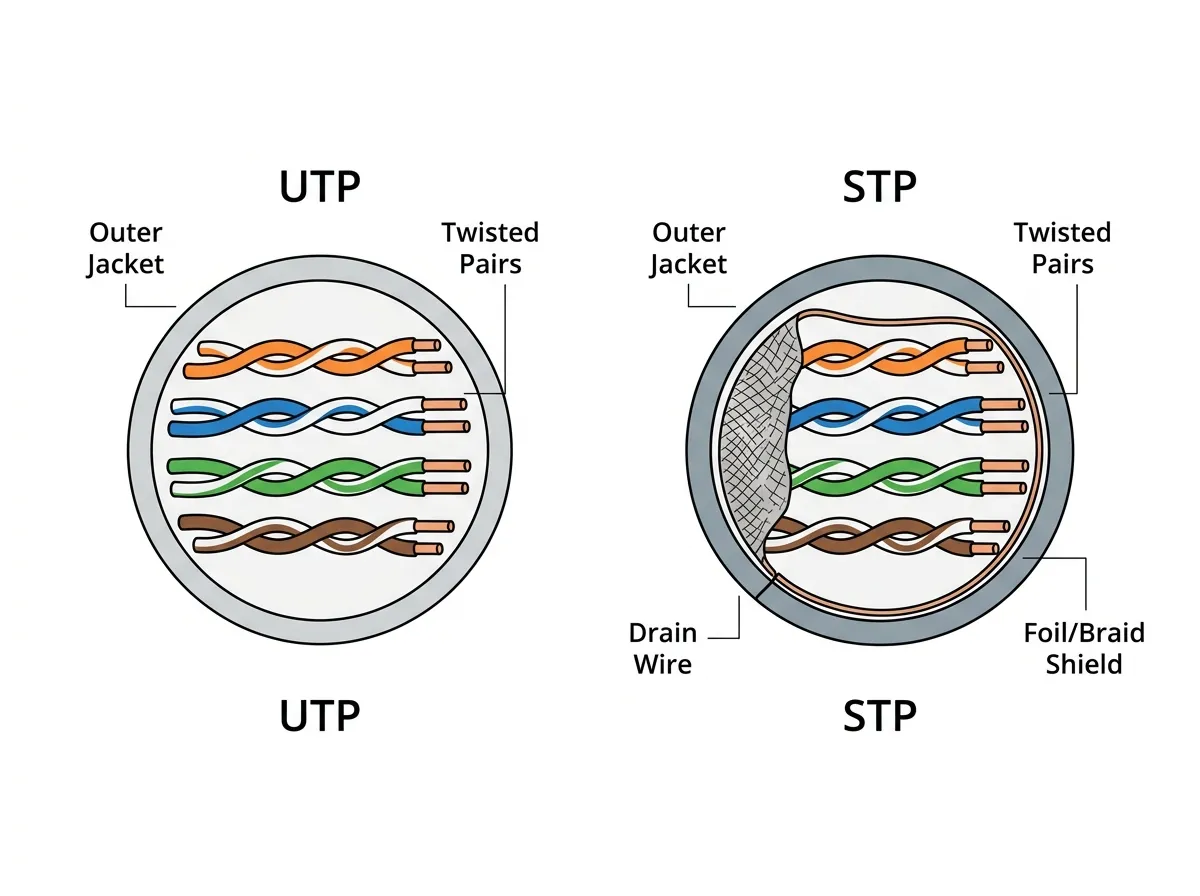
STP (Shielded Twisted Pair) adds a conductive shield (foil and sometimes braid) to block electromagnetic interference (EMI). Depending on the exact type, shielding may wrap the whole cable and or each pair. The goal is simple: reduce the amount of noise that reaches the conductors, especially in electrically loud areas.
STP makes sense when cables must run near strong interference sources, such as:
- Motors and compressors (HVAC rooms, factories)
- Elevator equipment and machine rooms
- Fluorescent light ballasts and large lighting banks
- Dense cable trays packed with power and data runs
Those environments can inject noise that raises errors and retransmits, even if the cable category is high. Shielding can lower that risk.
The tradeoffs matter on both the exam and the job. STP is often thicker and less flexible, which can make tight bends and crowded conduit harder. It costs more, and it usually takes more care to terminate. Shielded connectors and shield-aware patch panels may be required to keep the shield continuous from end to end.
A key point: shielding only works when it is installed correctly. STP needs proper grounding and shield continuity. If the shield is broken, floating, or grounded poorly, it can act like an antenna and bring in more noise. Exam-friendly warning to remember: badly grounded STP can perform worse than UTP. When you cannot guarantee correct grounding practices, UTP is often the safer choice.
Cable categories in plain English, Cat5e to Cat8 and what to remember
Cable categories describe tested performance levels for copper twisted pair. In practice, categories connect to two ideas you will see in A+: bandwidth (signal capability) and supported Ethernet speeds at common distances. Most office drops target a 100 m channel length, assuming good installation and compliant components.
Here is the high-level view you should keep straight:
| Category | Max Ethernet speed | Distance at that speed | Rated bandwidth | Notes |
|---|---|---|---|---|
| Cat5 | 100 Mbps | 100 m | 100 MHz | Legacy; no longer installed, still found in older buildings |
| Cat5e | 1 Gbps | 100 m | 100 MHz | Baseline for gigabit; tighter crosstalk limits than Cat5 |
| Cat6 | 1 Gbps (10 Gbps on short runs) | 100 m at 1 Gbps; 10 Gbps only to about 55 m | 250 MHz | Most common new install for gigabit desktops |
| Cat6a | 10 Gbps | 100 m | 500 MHz | Minimum category for full-distance 10 GbE; thicker, often shielded |
| Cat7 / Cat7a | 10 Gbps | 100 m | 600 MHz / 1,000 MHz | Fully shielded (S/FTP); ISO standard never adopted by TIA; its GG45/TERA connectors mean RJ-45 gear treats it like Cat6a |
| Cat8 | 25 Gbps / 40 Gbps | 30 m | 2,000 MHz | Data-center switch-to-server links only |
Exam tip: the classic trap is Cat6 vs Cat6a. Both can run 10 Gbps, but only Cat6a is rated to do it over the full 100 m channel; Cat6 gives up at roughly 55 m (less with a sloppy install). If a question asks for the minimum category for 10 GbE at 100 m, the answer is Cat6a.
A simple memory aid that stays true in the field: higher category usually means better noise handling and higher potential speeds, but only if the install is clean. A kinked cable, crushed jacket, too much untwist at the jack, or a sloppy patch panel can erase the advantage of a higher category.
If you want one practical rule to remember for troubleshooting, use this: when a link flaps or negotiates at a lower speed than expected, check the basics first (damage, termination, bend radius, and pair integrity) before blaming the category printed on the jacket.
Plenum-rated vs riser-rated vs PVC jackets, choosing based on fire and smoke rules
Cable jacket ratings are not about speed, they are about fire behavior and smoke. This is a frequent source of confusion because the cable looks similar from the outside. On the exam and in real installs, the jacket type must match the building space and local code.
A plenum space is part of the building used for air circulation, such as air-handling ducts and many drop-ceiling return-air areas. If a fire occurs, smoke and toxic gases can spread fast through these paths. Plenum-rated cable (often marked CMP) uses materials designed to produce less smoke and fewer toxic fumes under high heat. That is why it costs more and is often required above ceilings used as air returns.
Riser-rated cable (often marked CMR) is intended for vertical runs between floors, such as in wall cavities or riser shafts. It has fire resistance appropriate for those paths, but it is not held to the same low-smoke standard as plenum cable.
General-purpose PVC jackets (often CM/CMG) are common for short runs or spaces that do not require riser or plenum ratings. They can be acceptable in many open office areas, but they may fail inspection if used where plenum or riser cable is required.
A quick decision rule that maps well to A+ expectations:
- Identify the space (plenum air return, riser, or general area).
- Follow local code and building policy (this can be stricter than a generic rule).
- When in doubt, ask facilities or check drawings before pulling cable.
If you remember one safety point, make it this: choosing the wrong jacket can turn a working network into a failed inspection, or worse, a serious smoke hazard.
Direct-burial copper cable, what makes it different outdoors
Direct-burial copper cable is designed to be placed in soil where moisture, pressure, and temperature swings are normal. Standard indoor cable can wick water, crack in cold weather, or degrade in sunlight. Direct-burial cable addresses those risks with materials and construction meant for outdoor exposure.
Common direct-burial features include water blocking (gel or water-swell tape) to stop moisture migration, a tougher jacket that resists damage from rocks and shifting soil, and UV resistance for any part of the run that sees sunlight. Some types also include armor to reduce damage from crushing or pests, depending on the environment.
Outdoor runs also raise electrical safety questions. Long copper runs outside can pick up voltage differences from nearby electrical systems or lightning activity. That is why outdoor cabling plans often include surge protection, bonding, and grounding considerations. The exact method depends on local code and the equipment used, but the principle is consistent: don’t treat an outdoor copper link like an indoor patch cable.
It is also common to use conduit even with direct-burial cable. Conduit adds physical protection, makes replacement easier, and can help with compliance in some areas.
One practical caution for installs and tickets: pay attention to the transition point where the cable enters a building. That entry needs protection from abrasion, water ingress, and strain. A small gap or sharp edge at the penetration can turn into intermittent faults months later. Proper bushings, sealant where required, and a neat handoff to indoor-rated cable (when applicable) prevent many “mystery outage” calls.
T568A and T568B wiring standards, how to terminate Ethernet without guesswork
T568A and T568B are the two accepted pinout standards for terminating twisted-pair Ethernet on RJ-45 connectors and keystone jacks. Both work. The problems start when a site mixes them without a plan, or when a termination breaks the wire pairs and adds noise.
A simple way to think about it is this: the connector is a tiny “finish line” for four twisted pairs. Your job is to keep each pair together as far as possible, land the correct colors on the correct pins, and repeat the same method every time. Consistency prevents the kind of intermittent link issues that waste hours.
What changes between T568A and T568B (and what stays the same)
The practical difference between T568A and T568B is small: the orange and green pairs swap positions.