Bluetooth is the short-range wireless technology that connects a headset to a phone, a mouse to a laptop, and a fitness tracker to an app. It is designed for a personal area network (PAN): a handful of devices within a few meters of one user, exchanging modest amounts of data with very little power. Wi-Fi is built to move a lot of data to an access point; Bluetooth is built to replace a short cable.
Where Bluetooth lives on the radio dial
Bluetooth uses the 2.4 GHz ISM band, from 2.402 to 2.480 GHz, which is the same unlicensed band used by 2.4 GHz Wi-Fi, microwave ovens, cordless phones, and many baby monitors. Classic Bluetooth divides that band into 79 channels of 1 MHz each and hops between them 1,600 times per second in a pattern that both devices know. Bluetooth Low Energy (BLE) uses 40 channels of 2 MHz. Because a Bluetooth link only sits on any one channel for a fraction of a millisecond, a burst of interference on that channel costs one hop rather than the whole connection.
That hopping is also why Bluetooth and 2.4 GHz Wi-Fi mostly coexist: modern devices use adaptive frequency hopping, which notices the channels a nearby Wi-Fi network is using and stops hopping onto them. The coexistence is not perfect. A busy 2.4 GHz access point sitting next to a Bluetooth speaker can still cause audio stutter, and a running microwave oven can knock out both.
Classes: how far the signal reaches
Bluetooth devices are grouped into power classes, and the class sets the practical range.
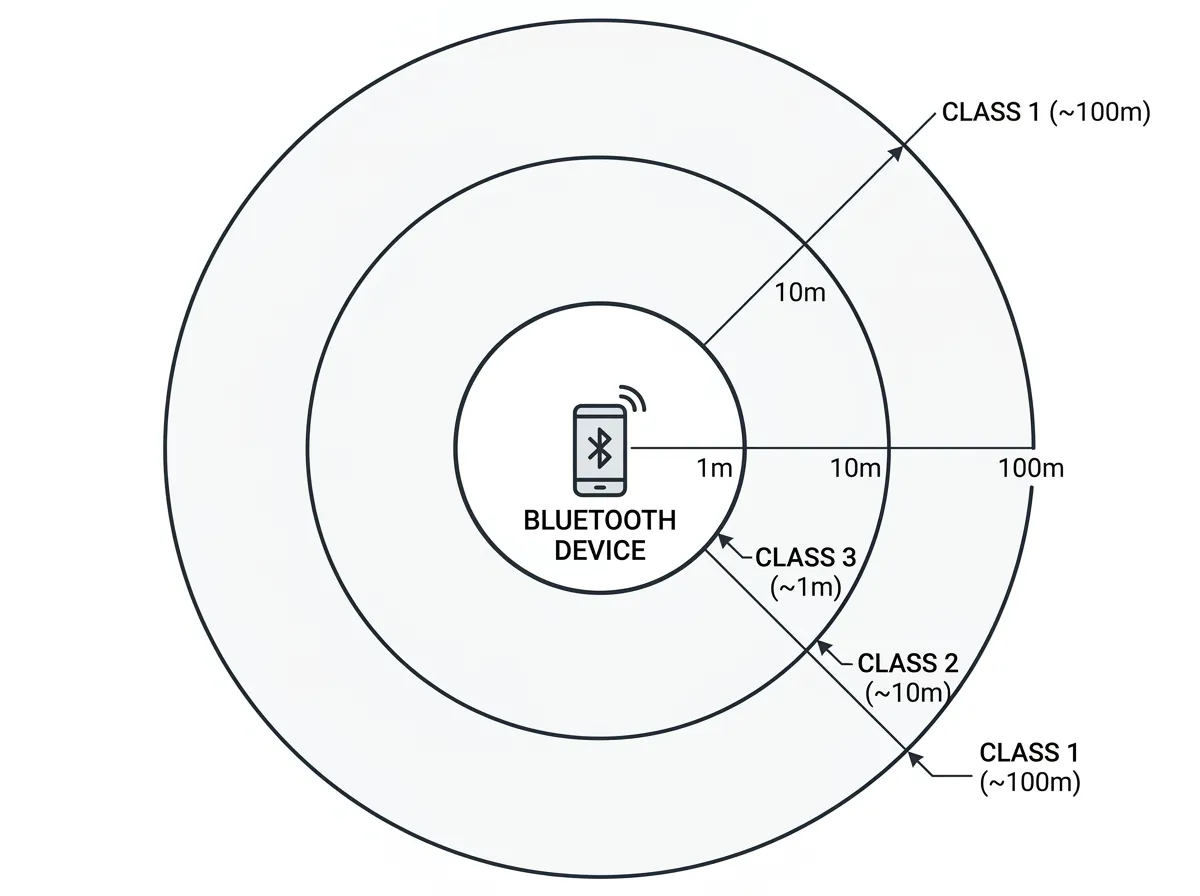
| Class | Maximum transmit power | Typical range | Typical devices |
|---|---|---|---|
| Class 1 | 100 mW (20 dBm) | About 100 m (330 ft) | USB dongles, industrial scanners, some laptops |
| Class 2 | 2.5 mW (4 dBm) | About 10 m (33 ft) | Phones, headsets, keyboards, mice, speakers |
| Class 3 | 1 mW (0 dBm) | About 1 m (3 ft) | Small, battery-critical accessories |
When the exam or a customer talks about "Bluetooth range," the answer is the Class 2 figure of roughly 10 meters, because that is what almost every consumer device uses. Walls, bodies, and metal desks reduce it further. A user whose headset drops when they walk to the kitchen is not suffering a fault; they are at the edge of a Class 2 link.
Versions: what changed and why it matters
You do not need release dates, but you should know what each generation added, because a device only gets a feature if both ends support it.
- Bluetooth 1.x and 2.x established the basics; 2.0 added Enhanced Data Rate (EDR) for about 3 Mbps. Devices this old often fail to pair with current phones.
- Bluetooth 3.0 + HS could hand large transfers to a Wi-Fi radio for speed; rarely used in practice.
- Bluetooth 4.0 introduced Bluetooth Low Energy (BLE), a separate low-power mode that lets a coin-cell sensor, tracker tag, or smartwatch run for months.