Where coax still shows up
Twisted-pair Ethernet carries almost every wired link inside a building, but the cable that brings the internet, television, and satellite feeds into that building is very often coaxial. You will meet it screwed onto the back of a cable modem, behind a TV wall plate, on the feed from a satellite dish, and occasionally as the leftover wiring of a very old Ethernet network. If a customer says "the cable guy ran a wire" or "the internet comes in on the round cable with the screw-on end," they are describing coax.
The exam expects you to recognize coaxial cable and its F-type connector on sight, know the two common grades (RG-6 and RG-59), and understand why it is used at the edge of the network rather than for desktop Ethernet drops.
How coaxial cable is built
Coaxial cable gets its name from its layers sharing the same axis. From the center outward:
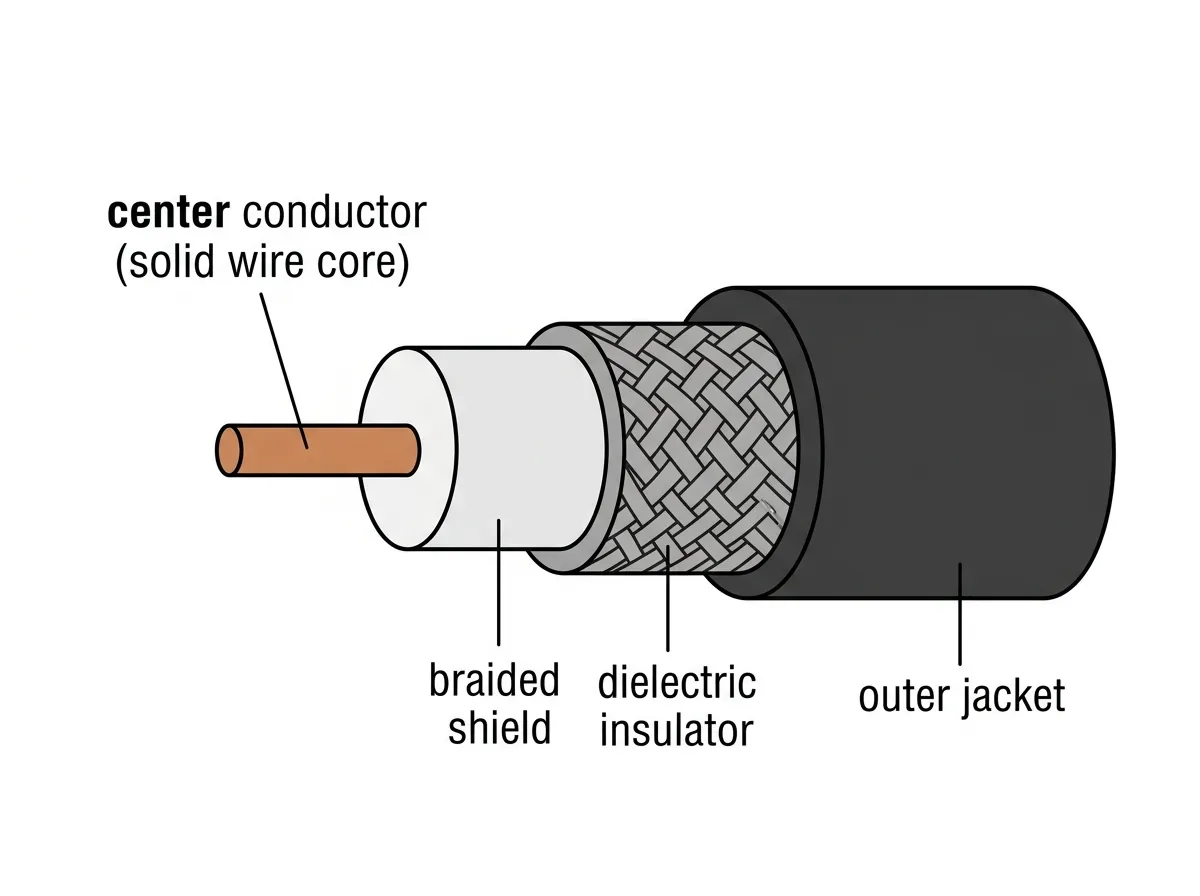
- Center conductor - a single solid copper or copper-clad steel wire that carries the signal.
- Dielectric insulator - a foam or solid plastic layer that keeps the center conductor exactly centered and sets the cable's electrical characteristics.
- Shield - a braided metal sleeve, usually combined with one or more foil wraps, that forms the signal's return path and blocks outside interference.
- Outer jacket - PVC for indoor runs, or a UV- and moisture-resistant jacket for outdoor and direct-burial runs.
Because the signal is completely enclosed by the shield, coax handles high-frequency signals over long distances with very little leakage in either direction. That is why cable providers can push hundreds of TV channels and multi-gigabit DOCSIS internet down one cable from the street to the house, and why the same cable does not interfere with the twisted-pair and Wi-Fi networks inside.
Compared with twisted pair, coax is thicker, stiffer, harder to terminate, and carries only one signal path per cable. It is not used for modern desktop Ethernet; a computer never plugs into coax directly. Instead the coax ends at a device (cable modem, set-top box, satellite receiver) that converts the signal and hands it off to Ethernet, HDMI, or Wi-Fi.
RG-6 and RG-59
Coax grades carry an "RG" number that comes from an old military specification. Two of them matter for A+:
| Type | Center conductor | Impedance | Typical use | What to remember |
|---|---|---|---|---|
| RG-6 | Thicker (about 18 AWG) | 75 ohms | Cable internet, cable TV, satellite TV, over-the-air antenna | The standard for any new installation; lower loss and better shielding than RG-59 |
| RG-59 | Thinner (about 20 AWG) | 75 ohms | Older analog CCTV cameras, short baseband video runs, legacy in-wall TV wiring | Higher signal loss at high frequencies; do not use it for a cable modem or satellite feed |
RG-6 and RG-59 look similar and both accept an F-type connector, so read the printing on the jacket rather than guessing. A house wired for cable TV in the 1980s or 1990s may have RG-59 in the walls; it can still carry a few analog channels, but a DOCSIS cable modem or a satellite receiver on the end of a long RG-59 run will drop out, run slowly, or fail to lock onto a signal. The fix is to replace that run with RG-6.
You may also see RG-58 on the exam or in an old wiring closet. It is a thinner 50-ohm cable that was used for 10BASE2 "thinnet" Ethernet with BNC bayonet connectors and 50-ohm terminators on each end of the bus. It is obsolete for networking and should not be reused for TV or cable internet.