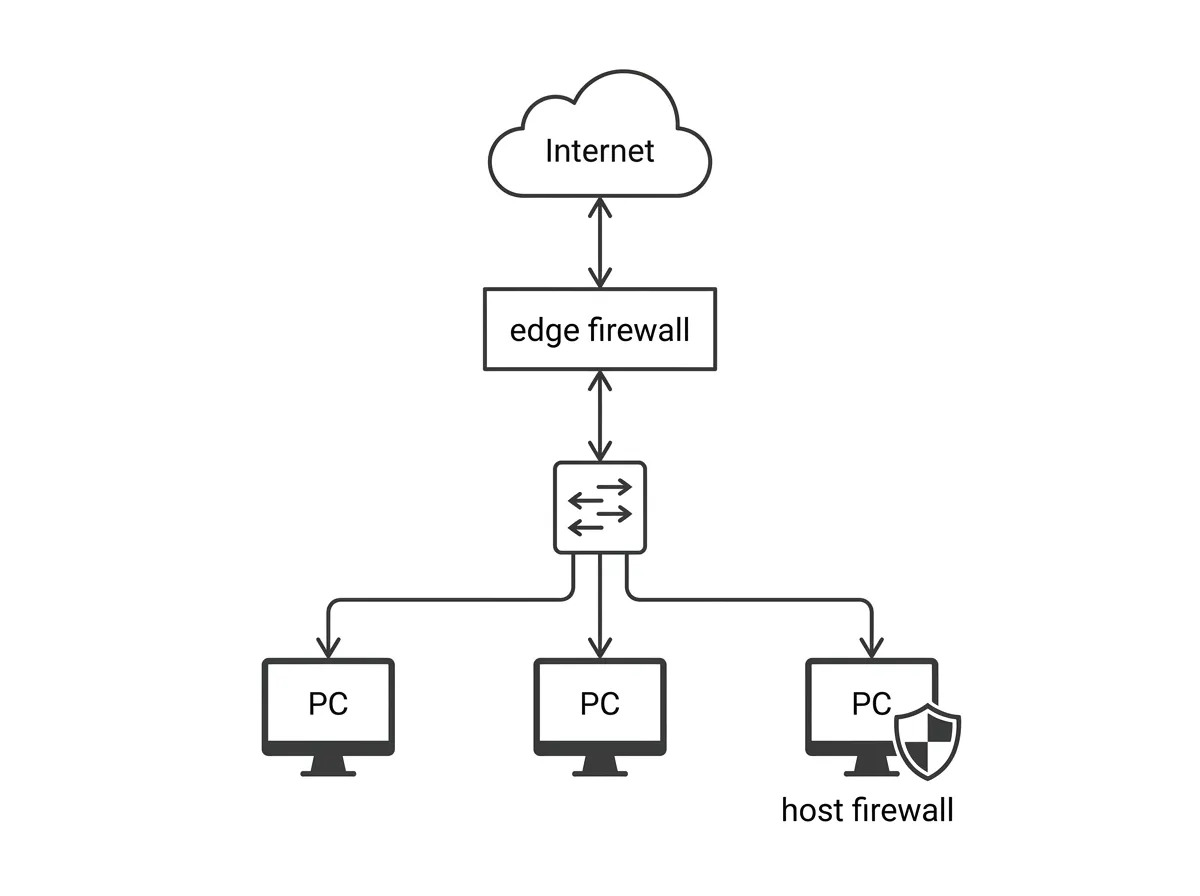
In an era where virtually every organization depends on networked computer systems, protecting those systems from unauthorized access and malicious activity has become a fundamental requirement. The firewall stands as one of the most essential security technologies in this effort—a digital barrier that monitors and controls network traffic based on predetermined security rules. Just as a physical firewall in a building prevents fire from spreading between sections, a network firewall prevents unauthorized or potentially harmful traffic from passing between networks.
This article provides a comprehensive examination of firewall technology, beginning with foundational concepts and progressing through the various types of firewalls, their operational mechanisms, deployment strategies, and limitations. No prior knowledge of firewalls is assumed, though a basic understanding of computer networking concepts such as IP addresses, ports, and protocols will aid comprehension.
.jpg?token=eyJraWQiOiJzdG9yYWdlLXVybC1zaWduaW5nLWtleV8xZjYxYWU5YS02YzVkLTRjZDktOGY4Mi0xMTAzMDc2N2E4YTIiLCJhbGciOiJIUzI1NiJ9.eyJ1cmwiOiJJbWFnZSA0L2ltYWdlICg3KS5qcGciLCJpYXQiOjE3NjkwOTMyNzksImV4cCI6MzM0NTg5MzI3OX0.TwOzcg2Wek3ZElFGPFUY1AakffSseNMkAgGpE43YG1A)
Foundational Concepts
What Is a Firewall?
A firewall is a network security device or software application that monitors incoming and outgoing network traffic and decides whether to allow or block specific traffic based on a defined set of security rules. Firewalls establish a barrier between trusted internal networks (such as a corporate local area network) and untrusted external networks (such as the internet).
To understand why firewalls are necessary, one must first appreciate the nature of network communication. When computers communicate over networks, they exchange units of data called packets. Each packet contains not only the actual data being transmitted but also header information that includes the source address (where the packet originated), the destination address (where it is going), and port numbers (which identify the specific application or service the packet is intended for).
Without any filtering mechanism, any device on the internet could attempt to send packets to any other device. This openness, while enabling the connectivity that makes the internet useful, also creates opportunities for malicious actors to probe systems for vulnerabilities, deliver malware, steal data, or disrupt services. Firewalls address this problem by examining packets and making decisions about whether to permit them to pass.
The Trust Boundary Concept
Central to understanding firewalls is the concept of trust boundaries. A trust boundary is a logical division between areas of different security levels. The most basic example is the boundary between an organization's internal network and the public internet. Devices on the internal network are generally considered more trustworthy because the organization controls them, maintains them, and restricts who can access them physically. The internet, by contrast, is entirely outside the organization's control and must be treated as inherently untrusted.
Firewalls are positioned at trust boundaries to enforce security policies governing what traffic may cross from one zone to another. In practice, organizations often define multiple trust zones beyond simple "inside" and "outside" distinctions. A company might establish a separate zone for servers that must be accessible from the internet (called a demilitarized zone or DMZ), another zone for sensitive financial systems, and yet another for guest wireless access. Each zone boundary represents a point where firewall controls may be applied.
Supporting Knowledge: How Network Communication Works
Before examining firewall operation in detail, it is helpful to review how network communication functions at a fundamental level. The dominant model for network communication is the TCP/IP protocol suite, which organizes communication into layers.
At the Network Layer, the Internet Protocol (IP) handles addressing and routing. Every device on an IP network has a unique IP address—a numerical identifier such as 192.168.1.100 (in the older IPv4 format) or 2001:db8::1 (in the newer IPv6 format). When data is sent across a network, IP ensures it is directed toward the correct destination address.
At the Transport Layer, protocols such as the Transmission Control Protocol (TCP) and User Datagram Protocol (UDP) manage the details of communication between specific applications. These protocols use port numbers to distinguish between different services running on the same device. For example, web servers typically listen on port 80 for unencrypted HTTP traffic and port 443 for encrypted HTTPS traffic. Email servers use port 25 for SMTP. When a packet arrives at a device, the port number tells the operating system which application should receive it.
A complete network connection is therefore identified by five pieces of information, often called the five-tuple: source IP address, source port, destination IP address, destination port, and protocol (TCP or UDP). Firewalls use these elements to make filtering decisions.
The Threat Landscape
Understanding why firewalls exist requires understanding the threats they are designed to address. Network-connected systems face a wide variety of potential attacks.
Unauthorized Access Attempts
Attackers routinely scan networks looking for systems with open ports and services that might be exploited. An attacker discovering an unprotected database server, for instance, might attempt to connect directly and extract sensitive information. Without a firewall, any service running on a network-connected machine is potentially accessible to anyone on the internet.
Malware and Ransomware
Malicious software often spreads across networks by exploiting vulnerabilities in services or by tricking users into executing harmful code. Once malware infects one system, it frequently attempts to spread laterally to other systems on the same network. Firewalls can limit this lateral movement by restricting which systems can communicate with each other and over which ports.
Denial of Service Attacks
In a denial of service (DoS) attack, an attacker floods a target system with so much traffic that it becomes unavailable to legitimate users. Distributed denial of service (DDoS) attacks amplify this technique by using many systems simultaneously. While firewalls alone cannot fully mitigate large-scale DDoS attacks, they can filter out some malicious traffic patterns and are often part of a broader defense strategy.
Data Exfiltration
Attackers who successfully compromise a system often attempt to extract valuable data—customer records, intellectual property, financial information, or credentials. This stolen data must be transmitted out of the network, typically over the internet. Firewalls monitoring outbound traffic can sometimes detect and block these exfiltration attempts, particularly when they occur over unusual ports or to suspicious destinations.
Exploitation of Vulnerable Services
Software vulnerabilities are discovered constantly. When a vulnerability is found in a widely used service, attackers race to exploit it before organizations can apply patches. A firewall that blocks access to vulnerable services from untrusted networks provides a layer of defense even when systems remain unpatched—a concept known as defense in depth.
How Firewalls Work
At their core, all firewalls operate on the same basic principle: they intercept network traffic at some point and apply rules to determine whether each packet or connection should be permitted or denied. The differences between firewall types lie in how deeply they inspect traffic and how sophisticated their decision-making can be.
The Rule Base
Every firewall maintains a rule base (also called a policy or access control list) that defines the criteria for allowing or blocking traffic. Rules typically specify conditions such as source address, destination address, port number, protocol, and sometimes other factors. When a packet arrives, the firewall evaluates it against the rules in order, usually from top to bottom, until it finds a matching rule. The action specified by that rule (permit or deny) is then applied to the packet.
Most firewalls follow an implicit deny principle, meaning that if no rule explicitly permits a particular type of traffic, it is blocked by default. This approach ensures that only traffic specifically authorized by administrators is allowed through. A typical rule base might include rules such as: allow outbound web traffic (TCP ports 80 and 443) from internal users; allow inbound connections to the company web server on port 443; deny all other inbound traffic from the internet.
Stateful vs. Stateless Inspection
Early firewalls examined each packet in isolation, making decisions based solely on the information contained in that individual packet. This approach, called stateless or packet filtering, has significant limitations. Consider a user browsing a website: the user's computer sends a request to the web server, and the server sends back a response. A stateless firewall examining the response packet sees only that it originated from an external server and is destined for an internal machine—without context, this might look like an unsolicited inbound connection that should be blocked.
Stateful inspection addresses this problem by tracking the state of network connections. When an internal user initiates a connection to an external web server, the stateful firewall records this connection in a state table. When response packets arrive from the server, the firewall checks the state table and recognizes them as part of an established, legitimate connection. This allows the firewall to permit response traffic without requiring explicit rules for every possible response.
Stateful inspection dramatically improves both security and usability. It allows administrators to write simpler rules focused on who can initiate connections rather than trying to account for all possible response traffic. It also provides better security because the firewall can reject packets that claim to be part of a connection but do not match any tracked session.
Types of Firewalls
Firewall technology has evolved considerably since its inception in the late 1980s. Modern networks may employ several different types of firewalls, each with distinct characteristics and appropriate use cases.
Packet Filtering Firewalls
The earliest and simplest type of firewall, packet filtering firewalls examine the header information of each packet and make allow/deny decisions based on source address, destination address, port numbers, and protocol. They operate at the Network Layer (Layer 3) and Transport Layer (Layer 4) of the OSI model.
Packet filtering firewalls are fast and efficient because they examine only header information without inspecting packet contents. They are often implemented in network routers, providing basic filtering without requiring separate hardware. However, their limitations are significant. They cannot track connection state (in their pure form), cannot examine application-layer data, and can be fooled by various evasion techniques. Packet filtering is best suited for simple filtering requirements or as a first line of defense supplemented by more sophisticated technologies.
Stateful Inspection Firewalls
Stateful inspection firewalls, as described above, maintain awareness of active connections and use this context when evaluating packets. They represent a significant advancement over simple packet filtering and became the dominant firewall technology through the 1990s and 2000s.
Beyond basic connection tracking, stateful firewalls often include additional intelligence about specific protocols.