Internet Protocol (IP) is the addressing and delivery system that every network conversation rides on. Whatever a device is doing, whether it's loading a web page, printing, or syncing email, the data travels as IP packets, and every one of those packets carries a source address and a destination address. This article is the framing lesson for the whole IP addressing section: what IP's job is, what an IPv4 address looks like, and the one decision every device makes with every packet it sends. The articles that follow it go deep on the individual pieces.

For CompTIA A+ Core 1 (220-1201), Objective 2.6 covers IP addressing and SOHO networks. Nearly every connectivity ticket a technician touches involves reading or correcting IP configuration, so the mental model in this article, an address plus a mask plus a gateway, is the foundation everything else in the section builds on.
IP's job in the network stack
IP provides logical addressing and packet delivery. When a device sends data, the data is broken into packets, and each packet is stamped with the sender's IP address and the recipient's IP address. Routers read the destination address on each packet and forward it hop by hop toward the right network, the same way a mailing address moves a letter through the postal system without either party knowing the route in advance.
Devices already have a hardware identifier, the MAC address burned into each network adapter, so why add another? MAC addresses are flat: they identify a device but say nothing about where it is. IP addresses are hierarchical, with a network portion and a host portion, which is what lets routers forward packets toward a network without knowing every device inside it. In practice the two work together: IP gets a packet to the right network, and the MAC address gets it to the right adapter on the final local segment.
The anatomy of an IPv4 address
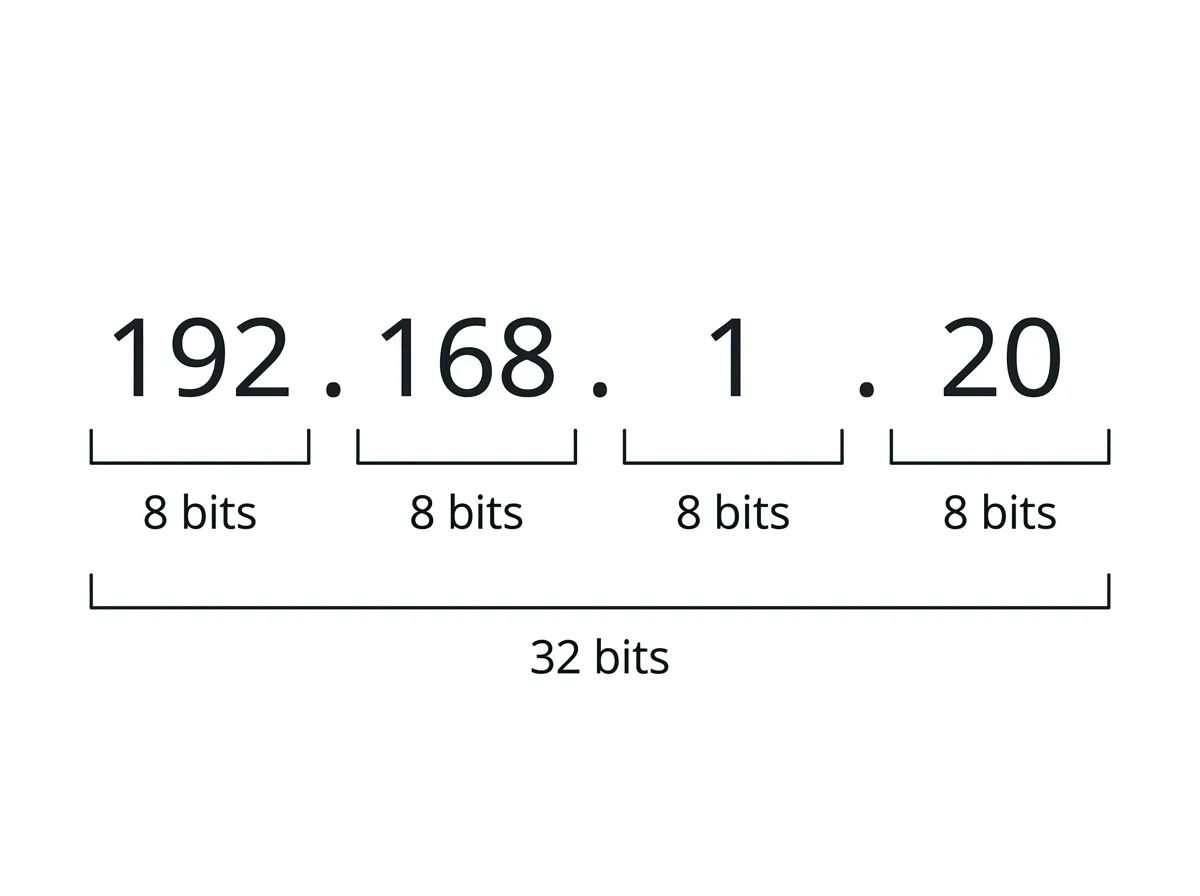
An IPv4 address is a 32-bit number, written for humans as four decimal numbers separated by dots, such as 192.168.1.20. Each of the four numbers is an octet, representing 8 bits, so each can range from 0 to 255. An octet of 256 or higher is your first clue an address was typed wrong.
An address never works alone.