
What is Attenuation?
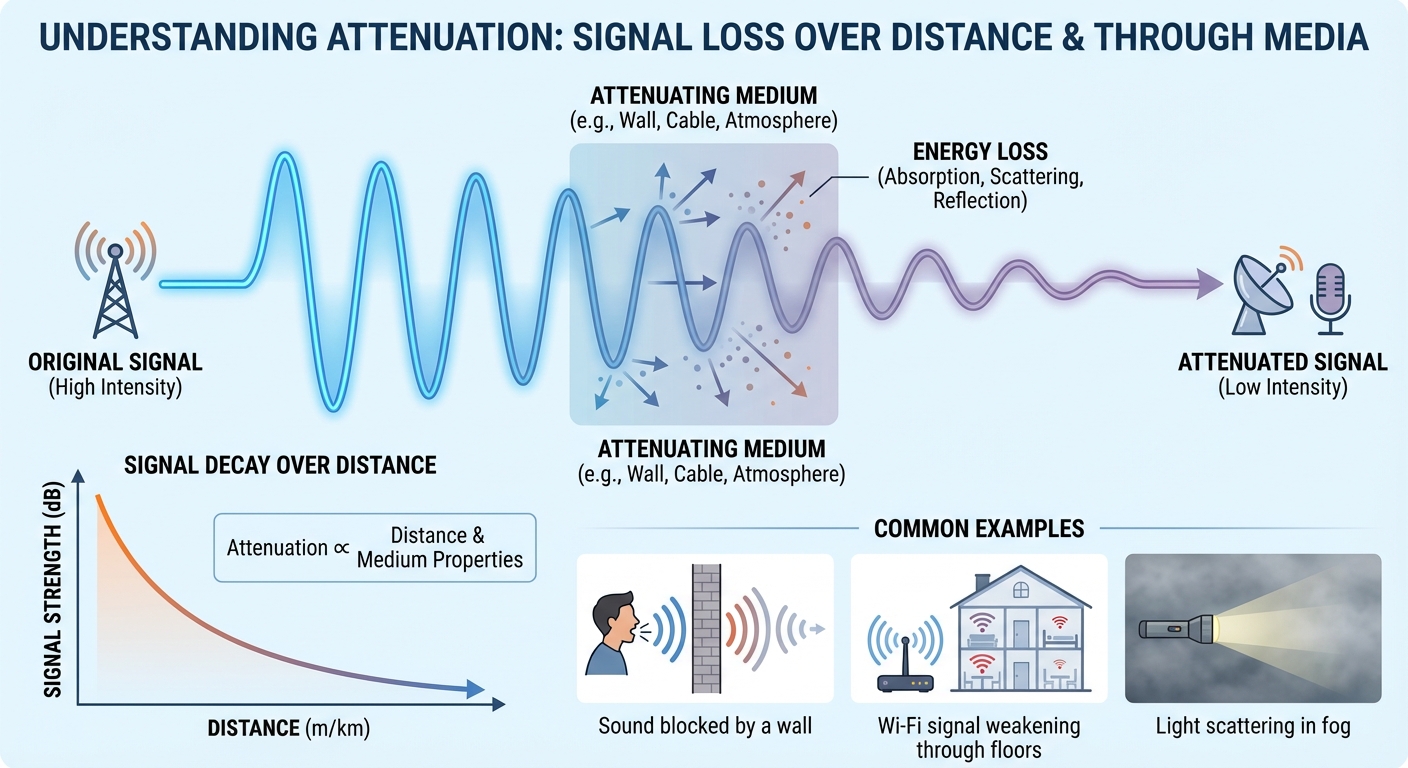
Attenuation refers to the gradual loss of signal strength or power as a signal travels through a medium or over distance. This reduction in signal intensity can be caused by various factors, including absorption, scattering, and dispersion, depending on the type of signal and the medium it is traveling through.
How Attenuation Works
Attenuation occurs due to the interaction between the signal and the medium it is traveling through. For example, in electronic circuits, the resistance of the wires and other components can cause the signal to lose power as it travels. In wireless communications, the signal can be attenuated by obstacles, such as buildings, trees, or even the atmosphere, which can absorb or scatter the electromagnetic waves.
The degree of attenuation depends on several factors, including the frequency of the signal, the distance it has traveled, the properties of the medium, and the presence of any obstacles or interference. Higher-frequency signals tend to experience more attenuation than lower-frequency signals, and longer transmission distances result in greater signal loss.
Importance of Attenuation
Understanding and managing attenuation is crucial in various fields, such as:
- Telecommunications: Attenuation affects the quality and range of communication signals, and it must be accounted for in the design and deployment of network infrastructure, such as cables, antennas, and amplifiers.
- Audio and Video Transmission: Attenuation can degrade the quality of audio and video signals, leading to issues like reduced volume, distortion, or loss of detail.
- Power Transmission: Attenuation in power lines can result in significant energy losses, which must be addressed through proper design and the use of power-boosting equipment.
- Medical Imaging: Attenuation of ultrasound or X-ray signals can affect the quality and accuracy of medical imaging techniques, requiring careful consideration of signal strength and propagation.
Mitigating Attenuation
To mitigate the effects of attenuation, various techniques can be employed, such as:
- Signal Amplification: Using amplifiers or repeaters to boost the signal strength at strategic points along the transmission path.
- Optimized Routing: Designing transmission paths that minimize the distance and obstacles, reducing the overall attenuation.
- Frequency Selection: Choosing signal frequencies that are less susceptible to attenuation in the given medium or environment.
- Adaptive Modulation: Adjusting the modulation scheme or transmission power to adapt to changing attenuation conditions.
Proper management of attenuation is crucial for ensuring reliable and high-quality signal transmission in a wide range of applications.