
TCP (Transmission Control Protocol)
A core communication protocol of the Internet Protocol Suite that provides reliable, ordered, and error-checked delivery of data between applications running on networked devices.
Key Characteristics:
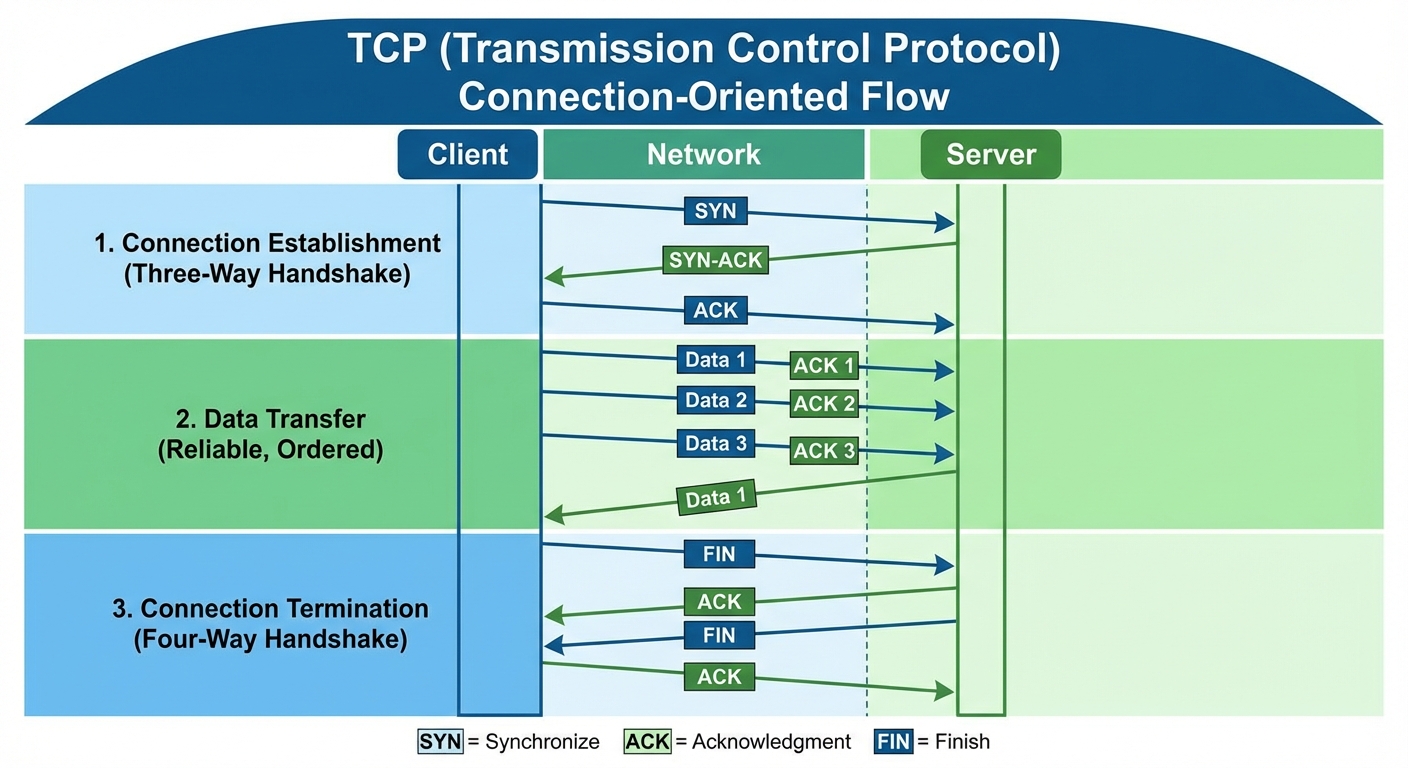
TCP is a connection-oriented protocol, meaning it establishes a dedicated connection between sender and receiver before transmitting data. It operates at the transport layer (Layer 4) of the OSI model and ensures that data packets arrive intact, in the correct sequence, and without duplication.
How It Works:
TCP uses a three-way handshake to establish connections (SYN, SYN-ACK, ACK) and implements acknowledgment mechanisms to confirm data receipt. If packets are lost or corrupted during transmission, TCP automatically retransmits them. The protocol also includes flow control and congestion control mechanisms to optimize network performance.
Common Uses:
- Web browsing (HTTP/HTTPS)
- Email transmission (SMTP, IMAP, POP3)
- File transfers (FTP, SFTP)
- Remote access (SSH, Telnet)
Contrast with UDP:
Unlike UDP (User Datagram Protocol), TCP prioritizes reliability over speed, making it ideal for applications where data accuracy is critical. UDP is faster but doesn't guarantee delivery or ordering.
Port Numbers:
TCP uses port numbers (0-65535) to identify specific applications or services, with well-known ports like 80 (HTTP), 443 (HTTPS), and 22 (SSH).